Versailles: From Promise to Power–Portrait of a Dauphine / Dessert Creation: Charlotte La Dauphine

Versailles was a place where beauty masked authority. Every room, ritual, and sound reflected the power of the crown. Music was one of the monarchy’s most persuasive tools—it filled the palace with constant motion: daily entertainments, dances, and ceremonies that reminded everyone of their place and reinforced the hierarchy. These performances dazzled and delighted, yet also shaped behavior and maintained order, turning art into an instrument of influence while reflecting the elegance and spectacle expected at court. At Versailles, beauty was never just decoration—it was power disguised as grace, and grace often came at a cost.
Jean-Philippe Rameau’s La Dauphine (1747), composed for the Dauphin’s marriage to Maria Josepha of Saxony, captures that tension: dazzling with courtly opulence, yet turning delicately inward—a moment when ornament gives way to reflection, and elegance reveals its humanity. It embodies both the splendor and the strain of perfection, echoing the life of a woman celebrated in public yet bound by expectation.
Into this world stepped the Dauphine herself, arriving not simply to marry but to strengthen political alliances. Every gesture, glance, and movement was measured—a living emblem of refinement whose role was to maintain the illusion of harmony within the hierarchy.
The dessert, Charlotte la Dauphine, mirrors that same world of display and restraint. Its ring of ladyfingers recalls the structure and boundaries of court life, while the jeweled shortbread crown atop the dessert directly symbolizes the Dauphine’s public role—the weight of her title, her ceremonial importance, and the power she represented. Inside, the layers of apricot, pineapple, and vanilla reveal the care and craft behind the surface, hinting at the humanity and effort contained within perfection.
The Piano Masterworks
At the heart of this program is Rameau’s La Dauphine, a piece written to honor a marriage of immense ceremonial importance. Unlike his other published works, it survives as a single, independent piece, transcribed from an improvised performance during the wedding festivities. The music sparkles with energy and precision, yet within its brilliance lies tenderness, as though Rameau glimpsed the young Dauphine’s uncertainty behind her regal composure.
In this performance, La Dauphine is joined by works of Jacques Duphly and Claude Balbastre, composers who shaped the sound of a court where art was both expression and expectation. Versailles itself was a theater of power - its gilded halls, mirrored galleries, and choreographed ceremonies designed to reflect control disguised as beauty. Yet within that perfection, one senses fragility: the quiet struggle to remain human amid the demands of display.
Together, these works trace the Dauphine’s symbolic journey from promise to power; a story of brilliance and restraint, splendor and silence, where art and identity intertwine beneath the weight of expectation.
The 3 Composers

Jean-Philippe Rameau (1683–1764)
Jean-Philippe Rameau was one of the most influential French composers of the 18th century and a central figure in the evolution of Baroque music. Appointed Compositeur du Cabinet du Roi under Louis XV, he composed operas, ballets, and harpsichord works that defined the musical language of the French court. His Treatise on Harmony (1722) established the foundations of modern tonal theory and reshaped how composers understood musical structure and progression.

Jacques Duphly (1715–1789)
Jacques Duphly (1715–1789) built on Rameau’s legacy, moving the harpsichord style toward clarity and lyrical elegance. His four volumes of Pièces de clavecin reflect the transition from the late Baroque to the early Classical period, documenting the refinement of French keyboard writing during the final years of the Ancien Régime.

Claude Balbastre (1724–1799)
Claude Balbastre was celebrated for his brilliance as both performer and composer. A student of Rameau’s brother, he became one of the most prominent musicians of his generation, performing regularly at Versailles and Notre-Dame. His works for harpsichord and organ combined technical virtuosity with bold harmonic language, bridging the grandeur of the monarchy and the turbulence of the Revolution.
The “Dauphine”

The title “Dauphin of France” was given to the heir to the French throne, and “Dauphine” to his wife. The name comes from the old province of Dauphiné in southeastern France, whose ruler, Guigues IV of Albon, used a dolphin on his coat of arms. When the province was sold to the French crown in 1349, it was agreed that the king’s eldest son would forever carry the title “Dauphin.”
Becoming a Dauphine meant entering one of the most visible and demanding roles in France. Her marriage was not only a family event but a political alliance, meant to strengthen ties between nations and to symbolize the future of the monarchy. Life as a Dauphine came with luxury and attention, but also strict expectations - every gesture and appearance reflected the image of royal power.
At Versailles, the Dauphine was both adored and constrained: a figure of beauty, duty, and control, representing the perfection the court expected and the pressure that perfection required.
The Charlotte Russe
The Charlotte Russe emerged in the early 19th century under the hand of Marie-Antoine Carême, one of the world’s first celebrity chefs, during his service to Czar Alexander I.
Carême transformed a simple apple pudding into an elegant Bavarian cream encased in a crown of biscuits à la cuillère (ladyfingers). His version elevated humble ingredients into a dessert worthy of royalty, combining structure, refinement, and theatrical presentation - much like the courtly world that inspired it.
Marie-Antoine Carême

Constructing the Charlotte
My dessert, Charlotte la Dauphine, is composed as a visual and structural echo of Versailles itself. The ring of ladyfingers encircles layers of delicate apricot crémeux, pineapple compote, and vanilla Bavarian cream, while on top rests a jeweled shortbread crown, its pearls set by hand with royal icing - a symbol of beauty carefully constructed and quietly restrained. Beneath its splendor lies something more intimate and sincere, echoing the humanity that shimmers beneath Rameau’s polished display.
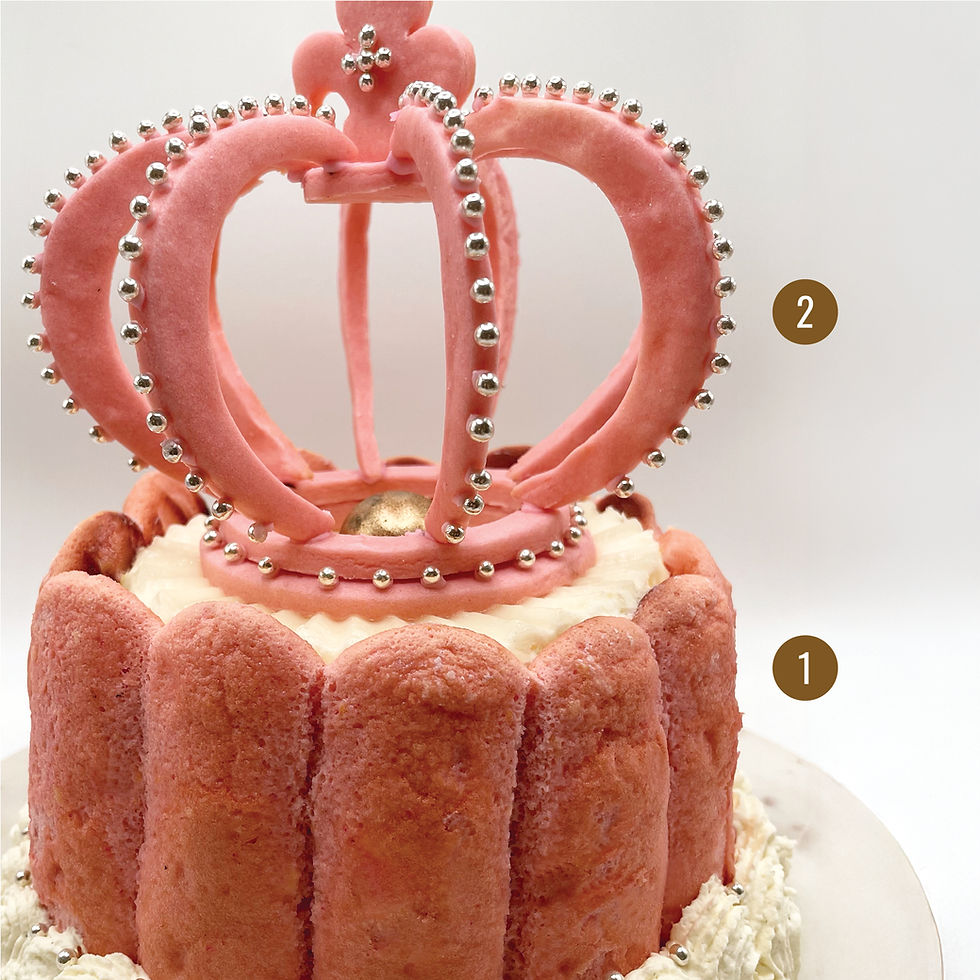
A ring of ladyfingers forms a delicate enclosure for alternating layers of apricot crémeux, pineapple compote, and vanilla Bavarian cream - textures that shift between firmness and softness, discipline and release.
Atop this stands a jeweled shortbread crown, each pearl of sugar affixed by royal icing, completing the image of ceremonial beauty and composure.
Layers of Flavor

The apricot cremeux, cherished in 18th century France, embodied refinement and radiance. Its golden hue and floral sweetness adorned the royal tables of Versailles in glazes, jams, and creams, celebrating the warmth of summer and the gentler side of luxury.
The pineapple compote, by contrast, represented rarity and display. Cultivated in heated glasshouses or imported at immense expense, it stood as an emblem of prestige and excess - a fruit whose very presence signaled privilege.
The vanilla Bavarian cream, softens the composition, its velvety texture and delicate perfume uniting the brighter fruit layers in harmony. Made from a classic crème anglaise lightened with whipped cream, it embodies refinement.
United, the apricot, pineapple, and vanilla form a dialogue of warmth, brightness, and calm - a harmony of flavors that reveals both strength and subtlety. Their interplay evokes the world of Versailles itself: radiant, composed, and alive with quiet tension beneath the surface.
The Component - Apricot Crémeux
Ingredients
150 g apricot purée
75 g heavy cream
45 g egg yolks (about 3)
40 g sugar
1¼ gold gelatin sheets (≈ 3 g)
80 g butter, softened
Method
Soak the gelatin sheets in cold water for 10 minutes.
In a small saucepan, whisk together the apricot purée, cream, yolks, and sugar. Heat gently, stirring, until thickened (82–84 °C / 180 °F); do not boil.
Remove from heat and stir in the softened gelatin until dissolved.
Cool slightly (≈ 40 °C), then blend in the butter until smooth and glossy.
Pour into a mold, cover, and chill or freeze until set.
Last Look

Comments